
Know your farm's emissions number before someone asks you for it.
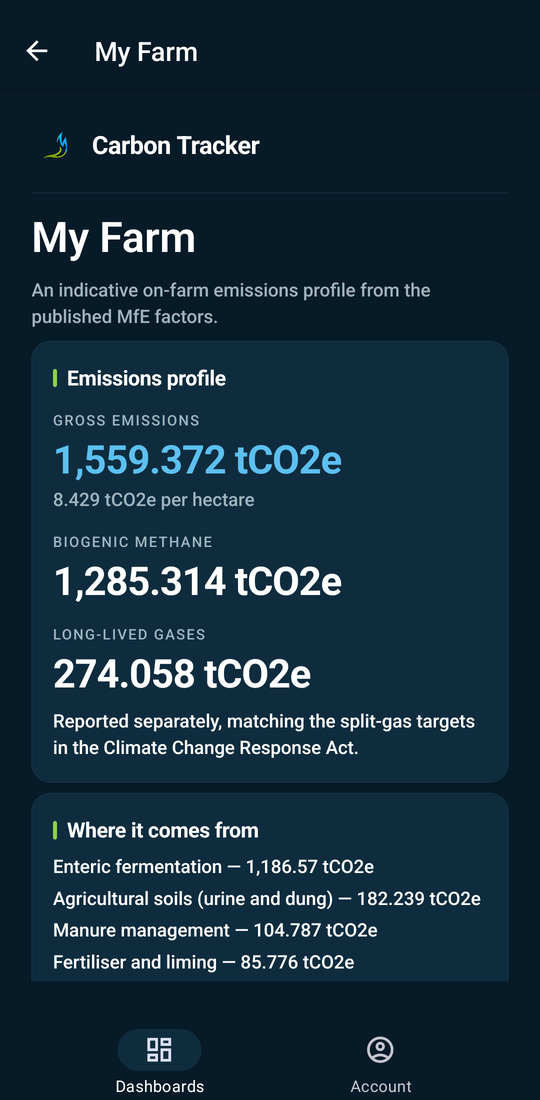
My Farm is a farm emissions calculator for New Zealand farmers. Put in your stock numbers and fertiliser and it gives you your annual emissions, split into biogenic methane and long-lived gases, with the published factor behind every line.
$99 a year plus GST. Card needed to start. Nothing is charged for 14 days, and you can cancel in one click before then.
- Dairy, beef, sheep, deer and more
- Split-gas reporting
- No ETS bill invented
Your farm has a number. The only question is who works it out.
Every farm in New Zealand produces greenhouse gases, mostly methane from stock and nitrous oxide from urine, dung and fertiliser. Agriculture is not in the Emissions Trading Scheme, and there is no farm-level return or bill in New Zealand law today. But the Government has said a farm-level pricing system will be in place by 2030, and your bank, processor or buyer may ask for the number well before then.
You can wait for someone else to tell you what your farm emits, or you can know it first. My Farm works out your figure from what you already have in the farm diary: average stock numbers and what went on the paddocks. It is the quickest way to see what drives your number and how it moves when your system changes.
What My Farm shows you
- Gross emissions for the year, in tonnes of carbon dioxide equivalent, and per effective hectare.
- The split-gas view. Biogenic methane and long-lived gases reported separately, matching the split-gas targets in the Climate Change Response Act.
- Where it comes from. Enteric fermentation, urine and dung on soils, manure management, and fertiliser and liming, each with its own total.
- Your obligation today. None. My Farm says so plainly, and lists what has actually been announced.
- Your trees beside your stock. If you also use the forest carbon dashboard, your registered forest and its units appear alongside your emissions.
Ten minutes with the farm diary. That is all it takes.
Enter this season's stock and fertiliser and see your number tonight. 14 days free, then $99 a year plus GST.
What you need to enter
No soil tests, no farm maps, no consultant.
Your stock
The annual average head of each class you run. Dairy cattle, non-dairy cattle, sheep, deer, goats, pigs, poultry, horses and more are covered.
What went on
Nitrogen fertiliser in kilograms of nitrogen, with urea, coated urea and non-urea kept separate, plus lime and dolomite by product weight.
Your effective hectares
Optional, but it gives you the per-hectare figure that makes one season comparable with the next.
A record you own, season after season
A one-off calculation tells you where you stood on one day. My Farm keeps each farm you run in your own account, so next season you update the stock numbers and see what changed. Run more than one property and each has its own profile. The factors come from the official Measuring Emissions catalogue and MPI explains how on-farm emissions are estimated, so you can see how national-average factors like these relate to the more detailed tools.
My Farm is honest about what it is. It uses national-average factors per head, so it will not capture every difference in feed, genetics or effluent management, and it may not match the figure your processor sends you. What it gives you is a consistent, sourced number you can produce on the spot and track over time. If your business also has fuel, electricity and freight to account for, the emissions ledger for business records those in the same sign-in.
Who should be using My Farm
- Sheep, beef, dairy and deer farmers who want their number before 2030 arrives.
- Farmers preparing for a conversation with the bank or a supply agreement.
- Farm advisers and accountants keeping profiles for clients.
- Anyone with both stock and trees who wants the whole picture in one place.
My Farm or waiting to be told?
| My Farm | Waiting | |
|---|---|---|
| When you know your number | Tonight | When somebody sends it to you |
| Who holds the record | You, in your own account | Someone else |
| Seeing what drives it | Broken down by source and by gas | A single total, if that |
| Trees and stock together | Yes, with the forest dashboard | Separate paperwork |
| Cost | $99 a year plus GST | Finding out late |
$99 a year for every farm you run.
Add My Forest for your trees for another $25 a year.
One dashboard
or $9.95 a month. My Farm on its own, for as many farms as you need.
Start free trialEach extra dashboard
or $2.50 a month. Add one to the same sign-in at any time, charged from the day you add it.
Start free trialAll four dashboards
or $15.95 a month. Forest, farm, obligations and the emissions ledger for the price of two and a half.
Start free trial- 14 days free on every plan. A card is needed to start and the first charge is on day 15.
- Cancel in one click from your account page. Cancel during the trial and you are never charged.
- Prices exclude GST. Paying yearly saves two months.
- Change dashboards, or switch between monthly and yearly, whenever you like.
Farm emissions questions, answered
Do New Zealand farmers pay for their emissions?
Not today. Agriculture is not in the ETS and there is no farm-level emissions return or surrender obligation in New Zealand law. The Government has said a farm-level pricing system will be in place by 2030, but its design and price are not settled.
What do I need to work out my farm's emissions?
Your annual average stock numbers by class, the nitrogen fertiliser you applied in kilograms of nitrogen, any lime or dolomite, and your effective hectares if you want a per-hectare figure.
What does split-gas mean?
New Zealand's targets treat biogenic methane separately from long-lived gases such as nitrous oxide and carbon dioxide. My Farm reports the two groups separately so your figures line up with those targets.
Will My Farm match the number from my processor?
Not necessarily. My Farm uses national-average factors per head, while processors and other tools may use different methods and more farm-specific detail. Both are estimates, and My Farm shows exactly which factors it used.
Which animals does My Farm cover?
Dairy cattle, non-dairy cattle, sheep, deer, goats, swine, poultry, horses, alpaca and llama, mules and asses, and emus and ostriches.
Can I track more than one farm?
Yes. Each farm has its own profile under the same sign-in, and the dashboard shows how many farms you are tracking.
Why is fertiliser entered as kilograms of nitrogen?
Because the published factors are per kilogram of nitrogen applied, not per kilogram of product. Lime and dolomite are the exception and are entered by product weight.
Does My Farm count the carbon in my trees?
Trees are tracked in the My Forest dashboard. If you have both, your registered forest and the units it has earned are shown next to your farm emissions.
Who can see my farm's figures?
Your figures are held in your own account behind your sign-in. You can delete your account, and everything in it, from the account page at any time.
How often should I update my numbers?
Once a season is enough for most farms. Update sooner if your stock numbers or fertiliser use change in a meaningful way and you want to see the effect.
Contact us
Running a mixed operation, or keeping records for several farms? Tell us how you are set up and we will help you get the profiles right. Or start the free trial and have your first number tonight.