
31 May does not move. Know your surrender number now.
My Obligations is the NZ ETS obligations calculator for businesses that must surrender units. Enter your tonnes, litres or kilograms and it shows the units you owe for each activity, what you already hold, and what the shortfall will cost.
$99 a year plus GST. Card needed to start. Nothing is charged for 14 days, and you can cancel in one click before then.
- Waste, fuel, coal, gas and HFCs
- Unique emissions factors
- Regulation cited on every figure
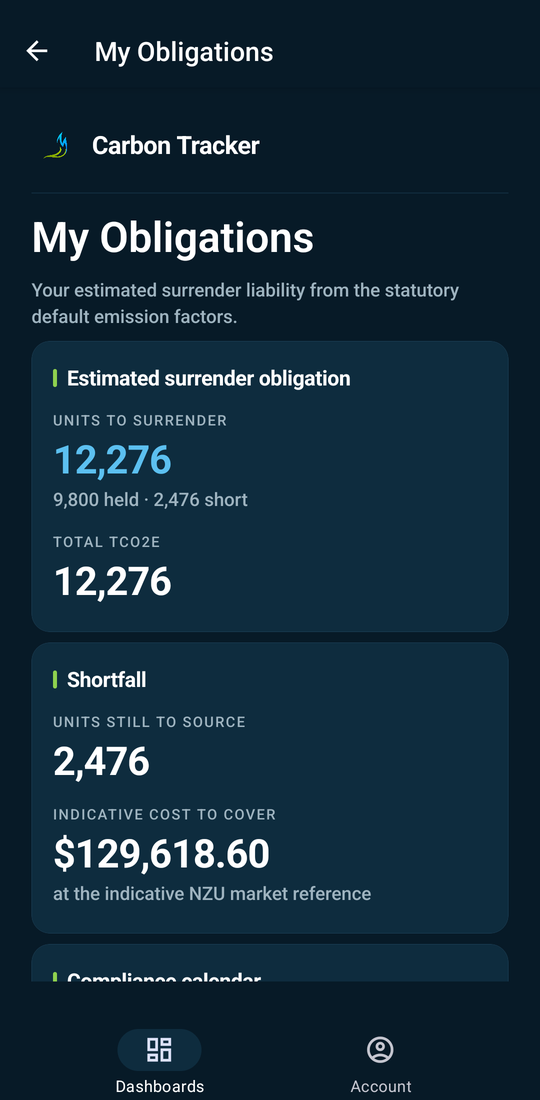
An obligation you can see coming is one you can budget for
If your business disposes of waste at a landfill, supplies liquid fuel, buys coal or natural gas in obligated quantities, or imports HFCs, you are in the Emissions Trading Scheme whether it is your core business or not. Each year you report your emissions and surrender one New Zealand Unit for every tonne. The Environmental Protection Authority administers the scheme and the dates are fixed in law.
The risk is rarely ignoring the rules. It is doing the sum once, in March, and finding out in May what units cost that week. My Obligations keeps a running position all year. Enter your activity as the figures come in and you can see the units building, compare them with what is in your Register account, and buy on your own timing instead of the calendar's.
What My Obligations shows you
- Units to surrender for each activity, calculated with the emissions factor in the regulation for that activity.
- The regulation behind the figure. Every result names the schedule or regulation it came from.
- Coverage. Enter the NZUs you hold in your Register account and see how much of the obligation they cover.
- The shortfall and the cost to cover it, at the indicative market reference price.
- The compliance calendar. Emissions return by 31 March, surrender by 31 May, for the previous calendar year.
Find the shortfall in October, not in May.
Enter this year's activity so far and see where you stand. 14 days free, then $99 a year plus GST.
Five obligated activities, each with its own regulation
Add as many activities as your business has. Each is calculated on its own and totalled.
Waste disposal
Annual tonnes of waste, less any diverted tonnes, at the default emissions factor or your approved unique emissions factor.
Liquid fossil fuels
Obligation fuel volumes in kilolitres by fuel class, net of biofuel content as the regulations require.
Coal
Annual tonnes by coal class, from lignite to bituminous, with the calorific value applied.
Natural gas
Annual energy in terajoules by gas field or class.
HFC imports
Kilograms of each gas or refrigerant class, converted with its global warming potential.
Made for the person who gets handed the ETS file
In most obligated businesses the ETS is one job among many for an operations manager, an accountant or the owner. My Obligations is built for that person. You do not need to know the schedules by heart: choose the activity, enter the quantity, and the factor is applied for you with its source shown. If you hold an approved unique emissions factor for your site, switch it on and enter it with its reference.
Because the cost side matters as much as the tonnes, the dashboard prices your shortfall at the same indicative market reference used on the Carbon Trader NZU marketplace, where you can buy the units you need. Forest owners on the other side of that trade use the forest carbon dashboard to see what they hold. And if you also report your wider footprint, the business emissions ledger keeps scope 1, 2 and 3 records in the same sign-in.
Who should be using My Obligations
- Landfill and transfer station operators, including councils.
- Fuel suppliers and distributors with obligation fuel volumes.
- Businesses that buy coal or natural gas in obligated quantities.
- Importers of HFCs and other synthetic greenhouse gases.
- Accountants and consultants who prepare ETS positions for clients.
My Obligations gives indicative figures to help you plan. Your emissions return is filed with the regulator, and the regulator's determination is the one that counts.
A running position or a March scramble?
| My Obligations | Once a year | |
|---|---|---|
| When you know your liability | All year, as figures come in | March |
| When you find the shortfall | In time to choose when to buy | Weeks before the deadline |
| Emissions factors | Applied from the current regulations | Looked up each year |
| Evidence for the board or auditor | Regulation shown on every figure | A spreadsheet tab |
| Cost | $99 a year plus GST | Buying at whatever the price is |
$99 a year against an obligation worth far more.
A shortfall found late is bought at whatever the price is that week.
One dashboard
or $9.95 a month. My Obligations on its own, for every activity you have.
Start free trialEach extra dashboard
or $2.50 a month. Add one to the same sign-in at any time, charged from the day you add it.
Start free trialAll four dashboards
or $15.95 a month. Forest, farm, obligations and the emissions ledger for the price of two and a half.
Start free trial- 14 days free on every plan. A card is needed to start and the first charge is on day 15.
- Cancel in one click from your account page. Cancel during the trial and you are never charged.
- Prices exclude GST. Paying yearly saves two months.
- Change dashboards, or switch between monthly and yearly, whenever you like.
ETS obligation questions, answered
Who has to surrender units under the NZ ETS?
Businesses carrying out activities listed in the Climate Change Response Act, including landfill operators, liquid fuel suppliers, coal and natural gas purchasers above the thresholds, and importers of HFCs.
When are the NZ ETS deadlines?
For these activities the annual emissions return for the previous calendar year is due by 31 March, and the units are surrendered by 31 May.
How is my surrender obligation calculated?
Your activity quantity is multiplied by the emissions factor set in the regulations for that activity to give tonnes of carbon dioxide equivalent. One unit is surrendered for each tonne.
Can I use a unique emissions factor?
Yes. If you hold an approved unique emissions factor, switch it on for that activity, enter the factor and its reference, and the calculation uses it in place of the default.
Does My Obligations connect to my Register account?
No. You enter the number of NZUs you hold, and the dashboard compares that with your obligation. Nothing is moved or traded from inside Carbon Tracker.
How is the cost to cover my shortfall worked out?
Your shortfall in units is multiplied by the indicative market reference price. It is a planning figure, not a quote, and the price you actually pay will depend on when and how you buy.
Does Carbon Tracker file my emissions return?
No. Returns are filed with the regulator through the official system. My Obligations gives you the working and the record beforehand.
How are biofuels treated for liquid fuels?
Volumes are entered net of biofuels. The regulations subtract the biofuel content within each fuel figure, so there is no single biofuel deduction to apply afterwards.
Can I track more than one site or activity?
Yes. Add each activity separately with its own name and reference, and the dashboard totals them into one surrender position.
What do I do if the dashboard shows a shortfall?
You will need to hold enough units before the surrender date. Many participants buy on the secondary market, and Carbon Trader is where you can do that.
Contact us
Have an activity or a factor that does not fit neatly? Tell us about your operation and we will show you how to set it up. Or start the free trial and have your position in front of you today.